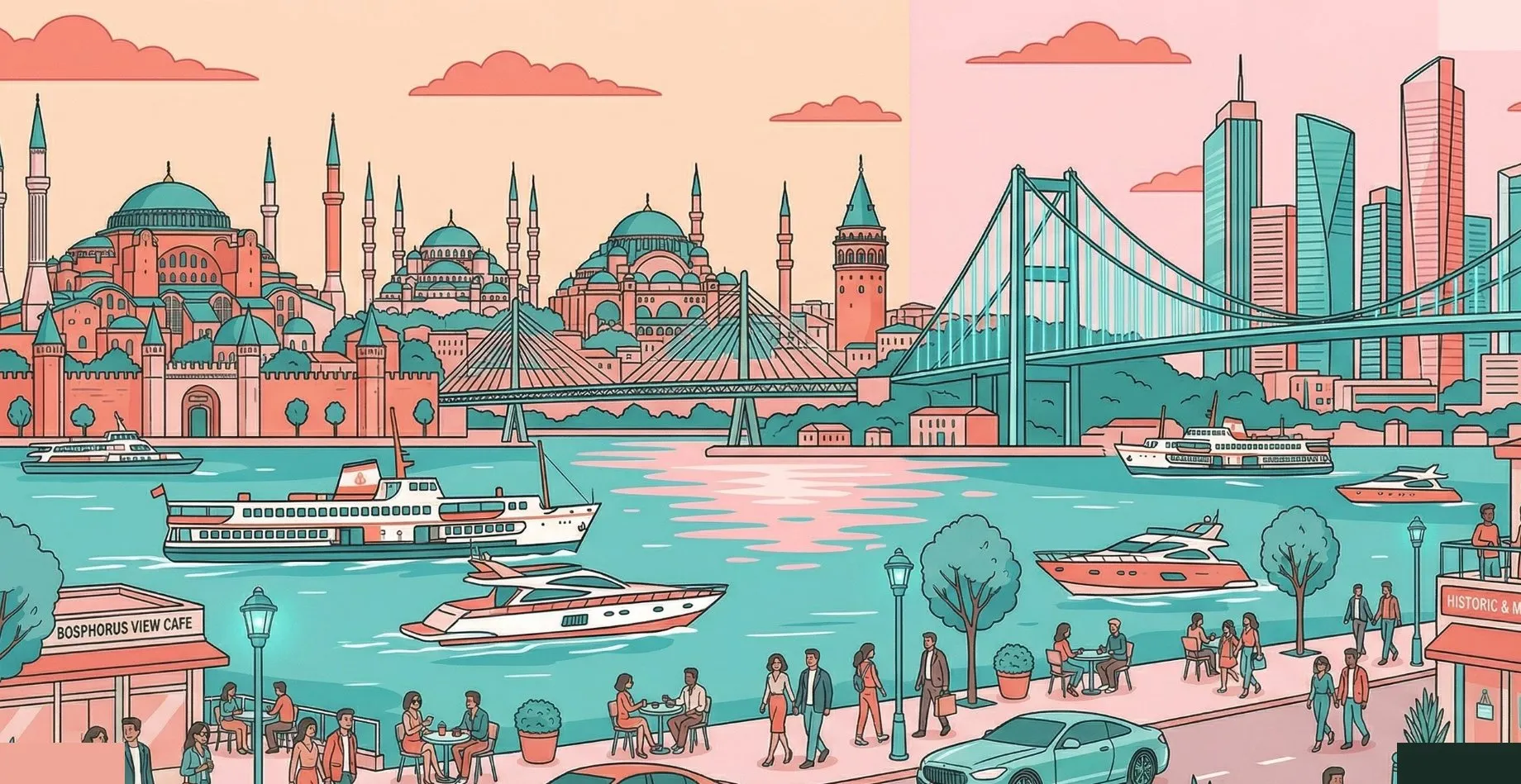
There are cities you visit, and there are cities that claim you. Istanbul does not wait for your permission. It pulls you in with the scent of roasted chestnuts on a November afternoon, with the cry of seagulls circling above the Galata Bridge, with the way the light falls on the Bosphorus at sunset and turns the water into liquid gold. You arrive as a stranger. You leave — if you ever do — as someone forever changed.
A City Between Worlds
Istanbul is the only city on Earth that straddles two continents. Stand on the shores of Uskudar on the Asian side, and you look across the water at Europe. Take a ferry from Kadikoy to Eminonu, and in twenty-five minutes you have crossed from one world to another. This is not a metaphor. This is your Monday morning commute. The French poet Pierre Loti, who fell in love with this city in the nineteenth century, would sit in the hilltop cafe that now bears his name in Eyup, watching the Golden Horn stretch below him like a painting that refuses to stay still. He wrote that Istanbul was not a place but a state of mind. He was right.
Want the places worth the trip? They're in the guideThirteen Million Stories
Thirteen million people call this city home. They speak in Turkish, Kurdish, Arabic, English, Russian, Farsi, and a dozen other languages. They pray in mosques that were once churches and churches that were once temples. They drink tea — always tea — in tulip-shaped glasses, and they argue about football with a passion that could power the city grid. Istanbul is not a melting pot. It is a mosaic. Every piece is distinct. Every piece is essential.
The Weight Of History
Few cities carry the weight of history the way Istanbul does. This is Constantinople, the capital of the Roman Empire after Rome itself fell. This is the city where Justinian built the Hagia Sophia in 537 AD and declared, according to legend, Suleiman I have surpassed thee — speaking to King Solomon himself. For nearly a thousand years, the Hagia Sophia was the largest cathedral in the world. Stand beneath its dome today and look up. The gold mosaics shimmer in the half-light. Byzantine angels look down at you across fifteen centuries. You feel small. You are meant to.
When Sultan Mehmed the Second conquered the city in 1453, he was twenty-one years old. He rode his horse through the gates of a city that had resisted siege for over a thousand years. He walked into the Hagia Sophia, touched the walls, and ordered it converted into a mosque. Then he declared Istanbul the new capital of the Ottoman Empire. For the next five centuries, this city would be the center of a civilization that stretched from Vienna to Yemen, from Algeria to the Caucasus.
The Bosphorus
The Bosphorus is not just a strait. It is the soul of Istanbul. It is thirty-one kilometers of water that separates and connects, that divides and unites. The currents run in two directions at once — fresh water flowing south from the Black Sea on the surface, salt water pushing north from the Mediterranean below. Like Istanbul itself, the Bosphorus cannot make up its mind, and that is precisely what makes it beautiful.
In the morning, fishermen line the Galata Bridge, their lines dropping into the water like threads connecting the present to a past that stretches back three thousand years. Ferries crisscross the strait, their horns echoing against the hills. Wooden yalis — Ottoman-era mansions — line the shores, their paint fading in colors that have no name in any language. At night, the Bosphorus Bridge lights up in colors that change with the hour, and the entire waterway becomes a mirror reflecting a city that never truly sleeps.
The Words Of Those Who Loved Her
Orhan Pamuk, Nobel laureate and Istanbul's most famous living son, wrote that the beauty of Istanbul comes from its melancholy — the Turkish word huzun. It is the sadness of a city that was once the center of the world and knows it. It is the beauty of decay, of faded grandeur, of a place that has seen everything and remembers all of it. Pamuk wrote: Istanbul's fate is my fate. I am attached to this city because it has made me who I am.
The great Turkish poet Nazim Hikmet, writing from exile, ached for Istanbul with every line. He wrote of the city's hills, its waters, its impossible beauty, and the pain of being separated from it. To love Istanbul is to understand that some cities do not just occupy a place on the map — they occupy a place in the heart.
Napoleon Bonaparte once said: If the Earth were a single state, Istanbul would be its capital. He understood what every conqueror in history has understood — that this city, by virtue of its geography alone, is the most strategic and desirable piece of land on Earth.
The Sounds
Close your eyes in Istanbul and you will still know exactly where you are. The call to prayer from five thousand mosques rising at dawn, layering over each other in a cascade of devotion that fills the entire sky. The clinking of tea glasses in a cay bahcesi. The honking of ferries. The shouting of simit sellers. The deep rumble of the Marmaray train passing beneath the Bosphorus, underwater, connecting two continents in four minutes. The laughter of children playing in the narrow streets of Balat, where colorful houses lean against each other like old friends. Istanbul is loud. Istanbul is unapologetically, magnificently loud.
The Food
You have not truly eaten breakfast until you have had a Turkish breakfast. A table covered in small plates — beyaz peynir, olives in seven shades of black and green, tomatoes and cucumbers cut fresh that morning, honey from the mountains of Macahel, kaymak so thick you could stand a spoon in it, and bread still warm from the firin around the corner. A glass of tea. Another glass of tea. Time stops. This is not a meal. This is a philosophy.
Walk through Kadikoy market on a Tuesday morning and your senses will surrender. Mountains of spices in colors that do not exist in nature. Fish so fresh they are still arguing about being caught. Dried figs stuffed with walnuts. Pomegranate molasses thick as memory. And everywhere, the smell of freshly ground Turkish coffee, the drink that gave the world the word coffee itself — from the Turkish kahve.
The Cats
No story of Istanbul is complete without the cats. They are everywhere — sleeping on mosque carpets, sitting on restaurant chairs like paying customers, perching on ancient walls like they own them. They do own them. Istanbul has been a city of cats for centuries. The Prophet Muhammad, it is said, once cut the sleeve of his robe rather than disturb the cat sleeping on it. In Istanbul, this story is not history. It is daily practice.
Why People Stay
People come to Istanbul for a week and stay for a lifetime. They come for the history and stay for the humanity. They come for the Hagia Sophia and stay for the tea. They come for the Bosphorus views and stay for the neighbor who brings them homemade borek on their first day. Istanbul is not easy. The traffic will test your patience. The bureaucracy will test your sanity. The summer heat will test your will to live. But the city gives back more than it takes. Always.
There is a Turkish expression — Istanbul, bir baska — Istanbul is something else. It is said with a shake of the head, a slight smile, and a look in the eyes that suggests the speaker has given up trying to explain and has decided instead to simply surrender to it.
This is the only honest response to Istanbul. You do not understand it. You do not conquer it. You do not even fully know it, no matter how many years you live here. You simply let it in, and you let it change you, and one day you realize that the city you came to visit has become the city you cannot imagine leaving.
Welcome to Istanbul. The city of the world's desire. The city that sits between dreams and memory, between East and West, between the ancient and the eternal. You are home now.
One email when something actually changes.
No weekly send and no filler — a short welcome note now, then an email only when a fee moves, a rule changes, or a new guide lands. I write them myself. Unsubscribe in one tap.
Have more questions?
Ask our AI assistant — built from 35 years of Istanbul experience.
Ask SettleIn AI →